Accessibility-by-Design in Messaging Platforms: Why Inclusive Communication Must Be Built Into Core Architecture
Introduction: Messaging Platforms as Essential Communication Infrastructure
Applications that were once informal consumer tools have become pillars of modern digital infrastructure. They currently enable both routine and mission-critical communication in the social, economic and civic realms. Messaging systems find extensive application in learning institutions to organize communication between students, teachers and administration; by employers to organize distributed workforces and support real-time collaboration; and by medical professionals to communicate with patients, organize care and exchange information more effectively. Messaging platforms are often used as the main ways of warning, instruction, and community response during the crisis and emergency cases.
With the integration of messaging systems into daily life, access increasingly determines whether people will be full participants in digital society. To individuals with disabilities, messaging apps are not a marginal product but the key to accessing education, finding a job, communicating with doctors, and being an active citizen. In the event of lack of access or inconsistency, exclusion occurs at a system-wide level. These consequences are not single-purpose usability problems but architectural failures that restrict partic
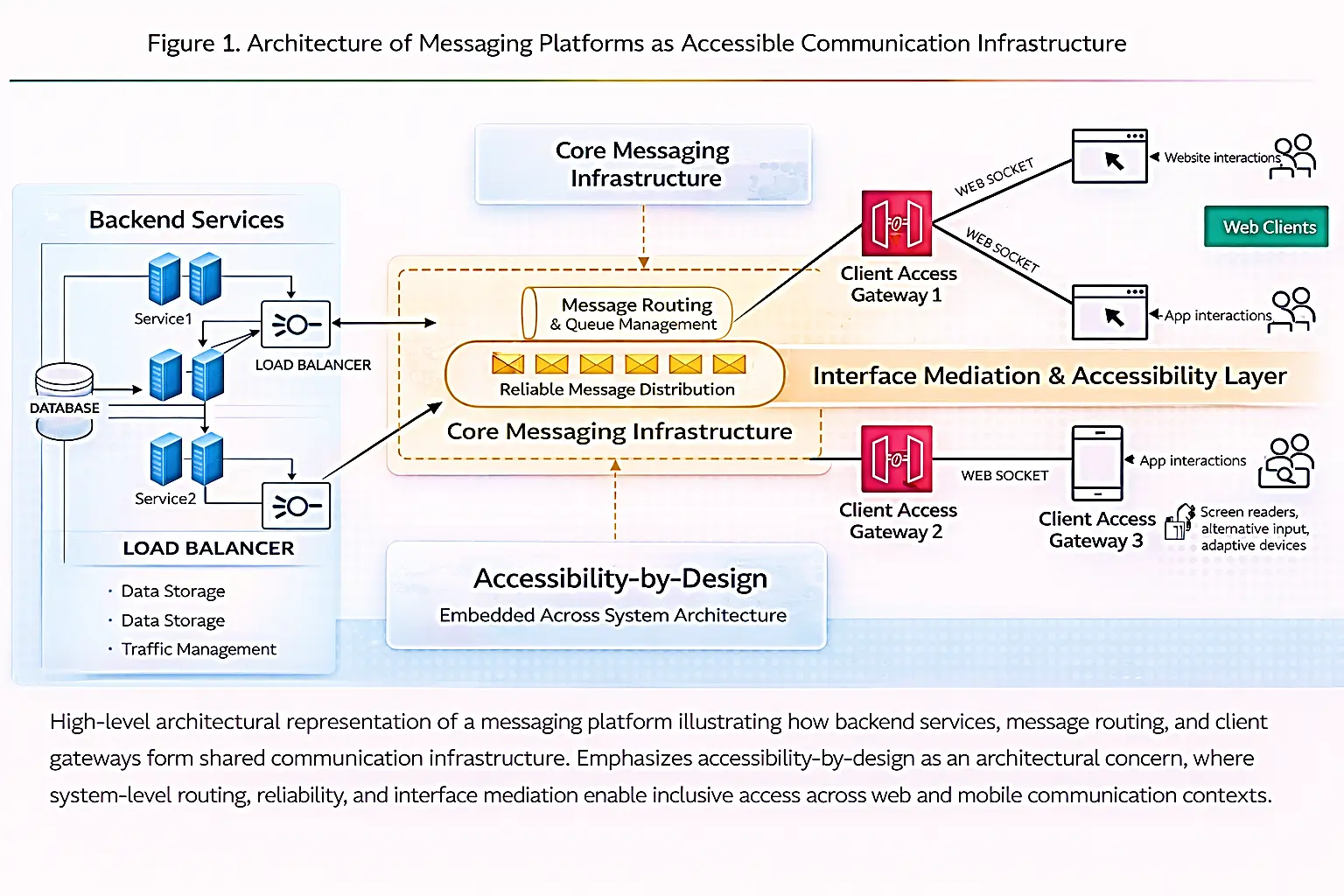
The architectural description of a messaging platform at a high level, showing how backend services, the message router, and the client gateways are integrated into common infrastructure of communication. It highlights the issue of accessibility-by-design as an architectural issue, and indicates how to provide accessibility to the system-level routing, reliability, and interface mediation to enable inclusive access across both web and mobile communication environments.
Accessibility-by-Design vs. Accessibility-as-a-Feature
There are two common approaches to accessibility in messaging platforms: retrofitted accessibility and an accessibility-by-design. Retrofitted accessibility treats inclusion as a collection of ad hoc features that are added to core systems. It is often a reactive strategy, benefiting the identified gaps by changing the interface or making isolated compatibility fixes. Although these measures can enhance usability in small-scale situations, they do not adequately address the structural conditions that delineate accessibility on a system-wide basis.
In comparison, accessibility-by-design views inclusion as an architectural notion that is integrated throughout a messaging platform at the very beginning of its creation. Accessibility in this approach is regarded as a non-functional system requirement similar to the security, reliability, and performance. Various user requirements inform the architectural decisions, in terms of data model, message flow, timing, interoperability of various devices, and interface mediation. Consequently, the feature of accessibility is always evident throughout the platforms, modes of interaction, and usage contexts as opposed to the post hoc remedial action.
Initial architectural choices play a decisive role in determining long-term accessibility. Decisions on message format, inter-session state management and interfaces between clients and core services have a direct impact on the capability to support assistive technologies, multimodal interaction and low-latency feedback. Late accessibility in design of systems introduces more or less rigid dependencies and assumptions into the system, which is hard to change without substantial redesign. These structural constraints are always likely to remain even amidst additions of new features.
Late-stage accessibility remediation is inherently limited in scalability. With the increase of complexity and user base of messaging platforms, retrofitted solutions are hard to maintain uniformly and consistently across devices and interaction scenarios. Incremental patches can enhance the accessibility of certain users and create fragmentation or regressions on other ones. By comparison, accessibility-by-design makes systems resilient and scalable through the inclusion of the various needs of users, by design.
Table 1. Accessibility-by-Design vs. Accessibility-as-a-Feature in Messaging Platforms
| Dimension | Accessibility-as-a-Feature (Retrofitted) | Accessibility-by-Design (Architectural) |
|---|---|---|
| Design Approach | Reactive; accessibility added after core system development | Proactive; accessibility embedded during system architecture design |
| Architectural Scope | Limited to interface or feature layers | Integrated across data models, message routing, and client mediation |
| Scalability | Difficult to maintain consistently as user base and system complexity grow | Scales naturally with system growth and multi-device expansion |
| Reliability | Inconsistent behavior across devices and interaction contexts | Predictable and stable accessibility outcomes across platforms |
| System Flexibility | Constrained by existing architectural assumptions | Supports diverse interaction modes and assistive technologies |
| Maintenance Effort | Requires ongoing patches and corrective updates | Reduced long-term maintenance through architectural alignment |
| Long-Term Impact | Partial inclusion with recurring accessibility gaps | Sustainable, system-wide inclusion over the platform lifecycle |
Core Accessibility Requirements for Messaging Platform Architecture
Core accessibility outcomes of messaging systems are largely determined by architectural choices, and not interface-related capabilities. When accessibility is treated as a system-level issue, then the needs of various types of human interaction across devices, situations and scenarios of use can be supported in a consistent way. The following requirements demonstrate how the inclusive results are based on architectural decisions instead of the separate technical extensions.
System architecture largely determines screen-reader compatibility. Support for assistive technologies is shaped by system architecture and exposure of messages, metadata and state of interfaces of interaction throughout the system. The semantics of content, order of message and state management allow information to be interpreted and presented reliably. When these aspects are dispersed or dismantled in the management of services, accessibility becomes hard to scale and maintain (Silva et al., 2025).
Text-to-speech and speech-to-text features also require heavy integration into the messaging system architecture. Such modes of interaction need predictable streams of messages, standardized content representations and predictable timing to be effective in both real-time and asynchronous communication. Interpretation of speech-based interaction as an essential system feature and not an add-on is an element of inclusive engagement among user with visual, hearing or motor disabilities and accessibility as a principle of design (Badii et al., 2009).
Accessibility is further supported by image description, media, and animated material. With the rich media forming part of the messaging systems, lack or inconsistent provisions of descriptive information may lock out users in meaningful relationships. Architectural support of connecting content and descriptive metadata allows that non-textual entities are available across platforms and assistive technologies, no matter what the client device, or what the interaction modality is (Harris et al., 2023).
Feedback in real-time is especially important in accessible interaction. Lateness, or unreliable reaction time, may disrupt the assistive processes, weaken the understanding, and reduce user confidence in the system. Latency and responsiveness are directly affected by architectural choices related to message routing, synchronization, and processing. Messaging platforms that are inclusive must also have architectures that place priority on predictable and timely feedback as a fundamental accessibility measure (Bogdanova et al., 2024).
Equitable access also requires cross-device and cross-context reliability. Assistive technologies, desktop environments, and mobile devices are often moved around by the user according to the situation and disability. The interrelatedness of architectural contexts operating in these environments would make sure that accessibility is not being compromised when interaction contexts vary. The ability to behave consistently across platforms promotes continuity in communication and makes messaging platforms dependable communication infrastructure.
The combination of these requirements proves that the outcomes of accessibility cannot be separated out of system architecture. Integrating these factors through the layers of messaging platform will allow reliable, scalable, and long-term communication systems.
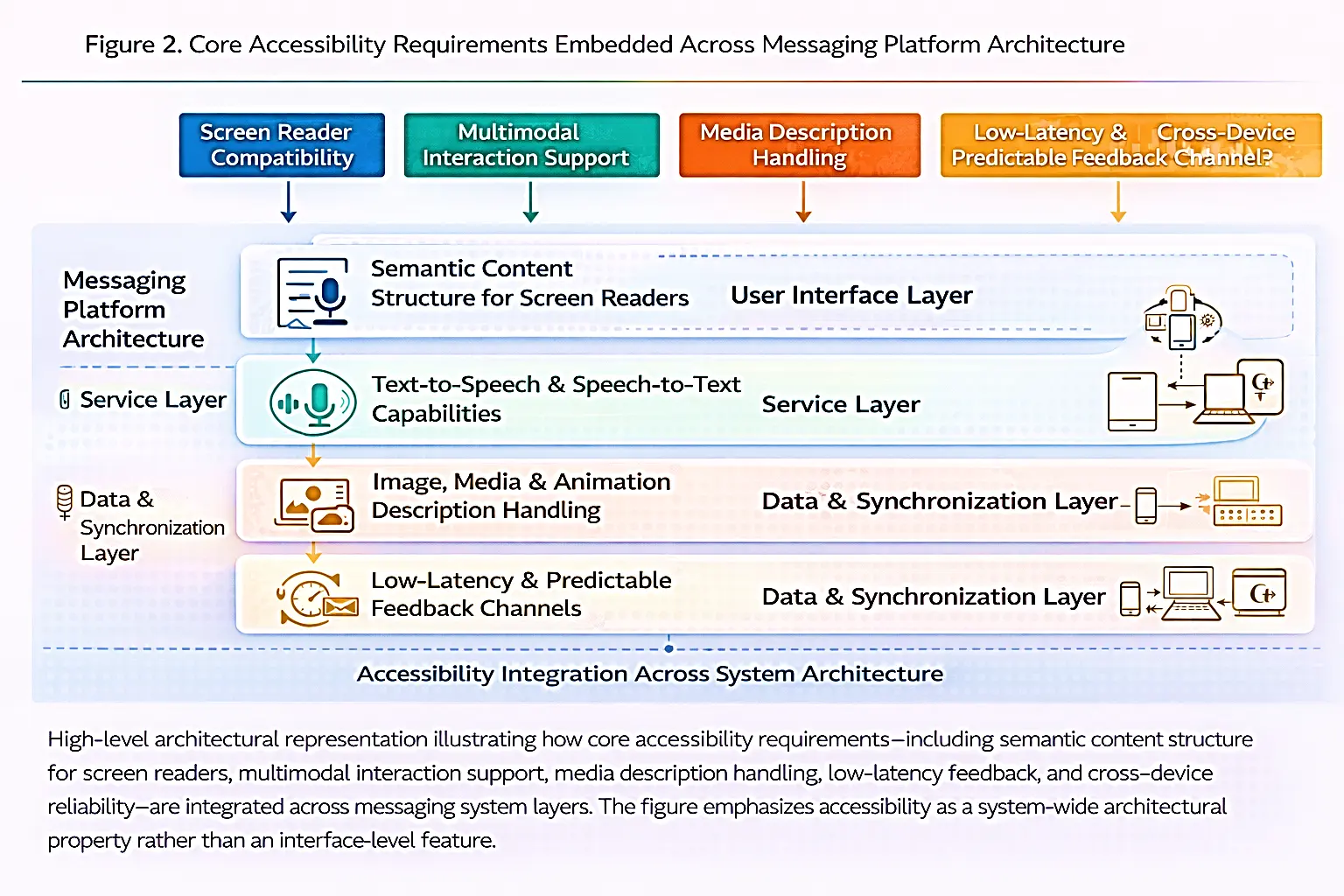
High-level architecture diagram illustrating how accessibility requirements, including semantic content structure to screen-reader systems, multimodal interaction, managing media descriptions, low-latency feedback, and cross-equipment reliability, fit in between layers of its messaging systems. The character is concerned with the accessibility as a system property rather than an interface property.
The Role of AI in Inclusive Messaging Systems
When utilized through concise architecture and governance guidelines, artificial intelligence increasingly functions as an enabling layer to the messaging systems architecture. On a broad scale, AI can promote inclusion in communication, helping to interpret, adapt, and communicate across diverse user requirements. Examples are facilitating multimodal communication, facilitating language and form translation, and helping users to follow complicated message streams. With careful consideration, AI can be used as an extension of accessibility-by-design values instead of substitutes (Silva et al., 2025).
Meanwhile, the use of AI in situations that require accessibility sensitivity poses considerable threats that need to be resolved at the system level. The issues of hallucinations and inconsistencies are also important because the output of AI can be distorted, incomplete, or out of context. These errors may confuse meaning, break communication, or hide important information, especially to those users who depend on mediated communication. The ability to vary between devices or sessions also compromises usability and predictability (Kotseruba and Tsotsos, 2020).
Another similar issue is trust erosion. Messaging platforms are very important communication media to users with disabilities, and erratic AI behavior may undermine confidence in the platform as a reliable communication medium. Once the support of accessibility functions on a non-descriptive manner and generates unexplainable differences, users can disengage or even revert to less efficient communication systems. Trust is lost, and it is hard to regain in systems that act as daily communication infrastructure (Harris et al., 2023).
More reliability issues are also associated with the treatment of AI-driven accessibility as an independent solution instead of the part of the bigger system architecture. Components of AI that are not controlled by core system guarantees (like timing, message consistency, or state consistency) may develop failure modes that have a disproportionate impact on users who are provided with assistive support. These dangers emphasize that these risks require careful architectural integration instead of the isolated or single deployment (Mendes et al., 2026).
To overcome these challenges, messaging systems have to apply AI in predictable and transparent applications with proper human supervision. The presence of predictable system behavior will enable users to construct credible expectations regarding the system behavior, whereas transparency will explain when and how AI mediation is implemented. Human control is necessary to ensure accountability, rectification of systemic mistakes and alignment of accessibility purposes. In this framing, AI plays the role of supportive infrastructure that improves the human-centered design and not a decision-maker.
Placed in the right location, AI can be used to enhance accessibility-by-design by expanding the range of adaptability and reach without pushing architectural accountability out of the game. Its contribution best works in the space where it is limited by the principles of the system that prioritize reliability, trust, and inclusion in all communication situations.
Table 2. Potential Benefits and Risks of AI-Assisted Accessibility in Messaging Platforms
| Dimension | Potential Benefits | Associated Risks |
|---|---|---|
| Interpretation Support | Enables transformation of content across modalities (e.g., text, speech, simplified representations) | Misinterpretation or distortion of meaning due to AI hallucinations |
| Adaptive Interaction | Adjusts communication to diverse user needs and contexts | Inconsistent behavior across devices or interaction sessions |
| Scalability | Extends accessibility support to large and diverse user populations | Difficulty maintaining uniform reliability at scale |
| User Experience | Reduces interaction barriers and cognitive effort | Trust erosion when system behavior is opaque or unpredictable |
| System Integration | Enhances accessibility when aligned with core architecture | Introduction of new failure points if loosely coupled to system guarantees |
| Governance & Oversight | Supports human-centered decision-making when properly supervised | Over-reliance on automated decisions without sufficient human oversight |
| Long-Term Impact | Reinforces accessibility-by-design as supportive infrastructure | Undermines inclusion if treated as an autonomous or corrective solution |
Privacy, Trust, and On-Device Processing
Privacy is one of the underlying accessibility issues in messaging applications and especially in assisted communication. Messaging systems are common among users with disabilities in education, employment, healthcare communication and civic activities. Such systems might have extremely sensitive data, such as personal identifiers, communication related to health, and other context information linked to assistive technology. In case of weak or ambiguous privacy provisions, access barriers arise when users avoid or limit use of systems that fail to address their privacy rights to autonomy and confidentiality (Harris et al., 2023).
The connections among trust, autonomy, and inclusive technology adoption are especially high in the context of accessibility. Reliability in a message platform will be based on more than just functional reliability, but the belief that personal information and content of communication are processed in a responsible manner. To users who depend on the help of accessibility, losing trust may directly become exclusion, since alternative communication channels might be restricted or unavailable. Transparency on architecture and uniformity with privacy guarantees are thus critical in the maintenance of the inclusive participation in the long run (Silva et al., 2025).
Here, edge processing and on-device processing can be valuable in terms of architecture. These methods minimize the need to depend on a centralized processing and constant network connectivity, and enable some accessibility capabilities to be brought nearer to the user. The reduced latency is especially useful in accessible interaction because a prompted feedback helps to understand, coordinate, and use assistive technologies effectively. The minimized latency also enhances predictability in the system, which strengthens user confidence in routine communication processes (Bogdanova et al., 2024).
The other most important benefit is increased availability. On-device and edge-based architectures can continue to provide critical accessibility functions can still provide accessibility during a network outage or a low-connectivity environment. This is especially applicable in cases of emergencies or when the resources are limited and the centralized services are absent, but communication is still needed. Architectural resilience also facilitates continuity of participation over intermittent or degraded access directly due to its accessibility (Mosca et al., 2019).
Accessibility is also facilitated by the privacy-sensitive architectural design, which reduces redundant exposure of data. The protection of user autonomy may be ensured through restricting the transfer of sensitive interaction information, decreasing the dependence on the centralized aggregation of the data, and specifying the location of processing. When privacy protection is implemented at the architectural level, accessibility features are more likely will be believed and uniformly embraced when the protection is achieved at the architectural level. In this respect, privacy and accessibility are mutually supporting design goals as opposed to conflicting priorities.
Collectively, these considerations underscore the relevance of architectural practices that combine privacy, trust and access. Messaging systems that implement on-device or edge processing as an accessibility-by-design approach can be more advantageous to provide a reliable, user-autonomy-respectful, and resilient inclusive communication strategy that will stand in a wide variety of use cases.
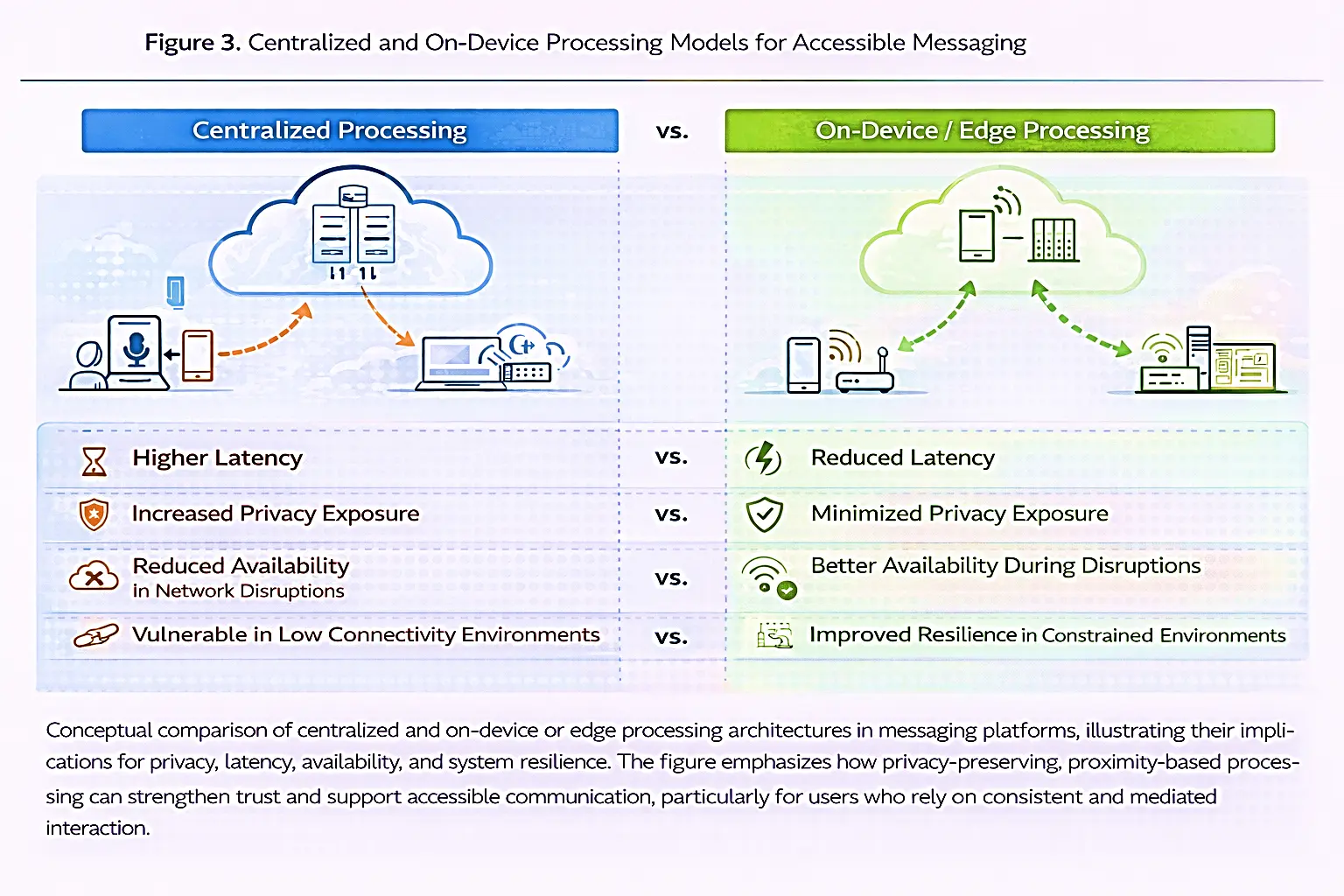
Conceptual comparison of centralized and on-device or edge processing models in messaging platforms, illustrating their effects on privacy, latency, availability, and system resilience. The figure highlights how privacy-preserving, proximity-based processing can strengthen trust and support accessible communication, particularly for users who rely on mediated and consistent interaction.
Alignment with Public Policy and Digital Equity Principles
The messaging platform accessibility methods are very much aligned to architectural approaches of access in architectural designs that acknowledge that access to communication is a social issue of concern. These structures though not technology specific have broad general principles that can give a concise explanation as to why accessibility should be considered as a prerequisite in the design of systems that serve as communication infrastructure.
On a broad plane, the Americans with Disabilities Act (ADA) provides the framework of the equality of people with disabilities to the services, which help them to participate in the social and economic life. Since messaging is taking over more and more educational, employment coordination, healthcare communication, and emergency interaction, the attributes of their accessibility have a direct impact on the feasibility of implementing this principle in the digital context. Messaging platforms are more appropriately placed to handle uniform and fair access in contexts of use when accessibility is integrated into system architecture as opposed to being considered as an isolated feature (Silva et al., 2025).
On the same note, section 508 of the Rehabilitation Act underlines accessibility in information and communication technologies employed by the institutions of the community. In addition to compliance issues, the bigger picture of this framework is that of architecture: the systems must be architected in a way that accessibility becomes a natural part of the information creation, transmission, and consumption process. Accessibility-by-design messaging platforms are also indicators of this systemic orientation, as they support inclusive use by all devices, modes of interaction, and assistive technology (Bogdanova et al., 2024).
In addition to legislative frameworks, there are larger digital equity plans that underline the significance of consistent, affordable, and available digital communication to be able to fully participate in the modern world. Such initiatives are becoming more conscious of the fact that the access disparity is not limited to connection but to be inclusive and easy to use of digital services. The architectural choices that the messaging platforms take receive a prominent place when they are perceived as systems of public-interest communication whereby the manner in which people can engage in digital life is dictated by parameters.
Considering accessibility as an equity and civil rights concern instead of a compliance item shifts the role of system designers and technology leaders. Accessibility-by-design focuses on active inclusion and sustainable design, making technical choices in favor of public-interest goals instead of remedial action. This perspective does not interpret legal requirements but is cognizant of the fact that architectural decisions have physical consequences of equity, autonomy, and participation.
In this regard, accessibility-by-design becomes a connection between the public policy goals and technical architecture. A more inclusive system-level can enable messaging systems to facilitate the purpose of digital equity frameworks and add to a more reliable, inclusive, and aligned communication system.
Table 3. Alignment of Accessibility-by-Design Principles with Public Digital Equity Goals
| Accessibility-by-Design Principle | Architectural Focus | Associated Digital Equity Goal |
|---|---|---|
| Architectural Integration | Accessibility embedded across system layers rather than added at the interface level | Equitable access to essential digital communication services |
| Consistency Across Contexts | Uniform behavior across devices, platforms, and assistive technologies | Continuity of participation in education, employment, and civic life |
| Reliability and Predictability | Stable system behavior and dependable interaction outcomes | Trust in digital communication as public-interest infrastructure |
| Multimodal Interaction Support | Support for diverse input and output modalities | Inclusion of users with varied sensory, motor, and cognitive needs |
| Privacy-Preserving Design | Minimization of unnecessary data exposure through architectural choices | Protection of autonomy and dignity in digital participation |
| Scalability of Inclusion | Accessibility maintained as systems grow in complexity and user base | Long-term sustainability of inclusive digital ecosystems |
Conclusion
Messaging systems have emerged as developmental components of critical communication infrastructure, which influence how people interact in areas of education, employment, healthcare organization, and civic activities, influencing the way people engage in education, employment, coordination of healthcare, and civic life. The nature of access to these systems in digital society determines by definition whose participation is meaningful in digital society as more of these systems mediate daily and critical interactions. Accessibility can no longer be treated as a feature, or as the addition of more functionality to a technology when it is conducted on this scale and with this level of societal significance.
Accessibility-by-design represents a long-term architectural requirement for messaging platforms. At the point where inclusion is integrated within main system architecture in addition to other requirements like security, reliability and performance, it becomes more consistent, scalable, and sustainable. The trajectory of accessibility is significantly more determined by architectural choices pertaining to the structure of the message, the time of interaction, the compatibility of the devices, the security of privacy and its stability than interface-level adaptations.
Framing messaging platforms as shared communication infrastructure that serves the interests of the general population highlights the importance of technologists and system architects to take accessibility as a guiding design principle. Access-by-design takes into account technical architecture in line with larger digital equity and civil rights ideologies, and is not based on reactive remediation or the implementation of narrow compliance strategies. It focuses on active accommodation, predictability and respect to user freedom of choice in various contexts of administration.
In the future, the further development of messaging platforms will be able to establish a more permanent niche in social and civic activities. Embedding accessibility at the architectural level is not only a technical best practice but a necessary condition for maintaining inclusive, trustworthy, and equitable communication systems over time that would allow maintaining the digital communication systems inclusive, trustworthy, and fair in the long run.
References
Silva, L., Pimentel, B., Duarte, B., Escarpini, R., Sousa, L., Cruz, N., & Silva, R. (2025). Accessibility by design: A systematic review of inclusive e-book standards, tools, and practices. Sustainability, 17(24), Article 11173. https://doi.org/10.3390/su172411173
Bogdanova, G., Todorov, T., Dochkova-Todorova, J., Noev, N., & Sabev, N. (2024). Design and development model of a web accessibility ecosystem. Information, 15(10), Article 613. https://doi.org/10.3390/info15100613
Badii, A., Fuschi, D., Khan, A., & Adetoye, A. (2009). Accessibility-by-design: A framework for delivery-context-aware personalised media content re-purposing. In A. Holzinger & K. Miesenberger (Eds.), HCI and usability for e-inclusion (USAB 2009) (Lecture Notes in Computer Science, Vol. 5889, pp. 183–197). Springer. https://doi.org/10.1007/978-3-642-10308-7_14
Mendes, I. F., Aljedaani, W., & Eler, M. M. (2026). Exploring knowledge and practices in digital accessibility assessment in the Brazilian software industry. Universal Access in the Information Society, 25(6). https://doi.org/10.1007/s10209-025-01284-6
Parra-Martínez, J., Gutiérrez-Mozo, M.-E., & Gilsanz-Díaz, A. (2021). Inclusive higher education and the built environment: A research and teaching agenda for gender mainstreaming in architecture studies. Sustainability, 13(5), Article 2565. https://doi.org/10.3390/su13052565
Harris, E., Franz, A., & O’Hara, S. (2023). Promoting social equity and building resilience through value-inclusive design. Buildings, 13(8), Article 2081. https://doi.org/10.3390/buildings13082081
Ryhl, C. (2016). Can you hear architecture: Inclusive design and acoustics in the Nordic region. In G. Di Bucchianico & P. Kercher (Eds.), Advances in design for inclusion (Advances in Intelligent Systems and Computing, Vol. 500, pp. 3–14). Springer. https://doi.org/10.1007/978-3-319-41962-6_1
Di Pace, S., Ippolito, A., & Vidal, F. J. (2024). Digital models and sensory substitution devices: An inclusive communication of architecture through sound. In L. Hermida González, J. P. Xavier, A. Amado Lorenzo, & Á. J. Fernández-Álvarez (Eds.), Graphic horizons (EGA 2024) (Springer Series in Design and Innovation, Vol. 43). Springer. https://doi.org/10.1007/978-3-031-57575-4_40
Mosca, E. I., Herssens, J., Rebecchi, A., Froyen, H., & Capolongo, S. (2019). “Design for all” manual: From users’ needs to inclusive design strategies. In S. Bagnara, R. Tartaglia, S. Albolino, T. Alexander, & Y. Fujita (Eds.), Proceedings of the 20th Congress of the International Ergonomics Association (IEA 2018) (Advances in Intelligent Systems and Computing, Vol. 824). Springer. https://doi.org/10.1007/978-3-319-96071-5_177
Carrión-Toro, M., Morales-Martínez, D., Santórum, M., Vizuete, A., Maldonado-Garcés, V., & Acosta-Vargas, P. (2025). PictoAndes: A customizable communication board for inclusive education and multicultural accessibility. Sustainability, 17(3), Article 956. https://doi.org/10.3390/su17030956
Kotseruba, I., & Tsotsos, J. K. (2020). Forty years of cognitive architectures: Core cognitive abilities and practical applications. Artificial Intelligence Review, 53, 17–94. https://doi.org/10.1007/s10462-018-9646-y